



Models, measurement & applied research
Between the lines.
I design models, test statistical methods, and implement research pipelines. The common thread is making the assumptions visible, then checking where they break.
01 / Sequence modelingWorking paper under revision
Modular Gated Attention
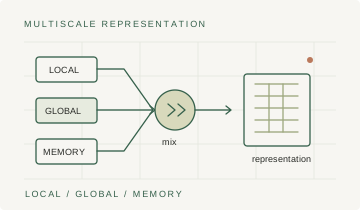
I built a PyTorch sequence layer that learns how to mix local attention, global latent context, and recurrent memory. Controlled tasks let me inspect when those mechanisms help—and when they don’t.
- Token-wise gates over three complementary information paths.
- Parameter-matched Transformer comparisons on copy and palindrome tasks.
- Length extrapolation, distractor noise, gate diagnostics, and module ablations.
02 / Causal inferenceIndependent methods note · 2025
Estimating effects, checking assumptions
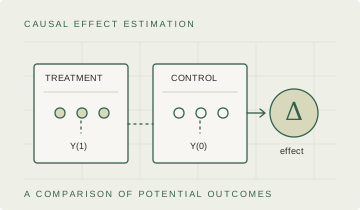
I compare six approaches to average treatment effect estimation in simulations where the true effect is known. The comparisons make tradeoffs in bias, uncertainty, and computation visible.
- Nearest-neighbor and full matching.
- Logistic and boosted propensity weighting; targeted maximum likelihood variants.
- Repeated-trial comparisons of bias, variability, interval coverage, and computation.
03 / Geospatial NLPManuscript in preparation
From place mentions to local data
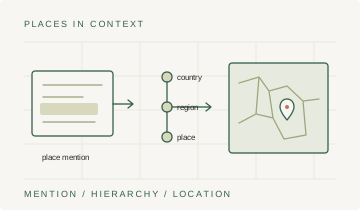
I develop an AI-assisted reconciliation layer that turns place mentions in translated news into consistent provinces and districts. Extracting a name is only the start; the harder problem is making it belong to the right geography.
- Combine extraction channels with country constraints and geographic knowledge.
- Repair aliases, check administrative hierarchies, and retain stable identifiers.
- Separate extraction from resolution errors; review ambiguous and unresolved cases.
04 / Political languageFramework & pilot · ongoing
Beyond tone: actions, reputation, framing
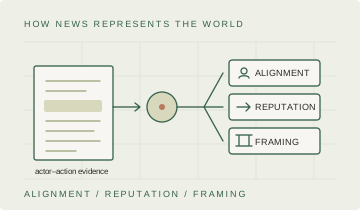
I’m implementing an evidence-grounded coding framework for media bias. A story can report opposition to a government while framing it sympathetically; a single sentiment score misses that distinction.
- Extract actor–action–target relationships with supporting text spans.
- Keep incumbent alignment, reputation implications, and framing separate.
- Use coding rules and human validation before comparing outlets, ownership, or polarization.
Structured extraction · attribution · construct validation
05 / U.S. foreign policyCollaborative working paper · 2026
Aid, policy & government reputation
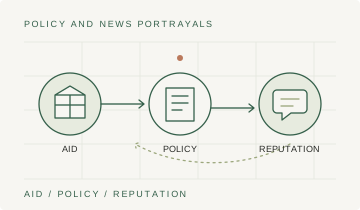
I build the classification and sentiment pipeline behind collaborative work on U.S. soft power and the elimination of USAID. It connects changes in aid policy with how the U.S. government is portrayed in domestic news.
- Fine-tune transformer classifiers for aid, defense, and diplomacy.
- Measure government-directed sentiment separately from an article’s general tone.
- Evaluate across sources and time; support topic-specific analysis and event studies.
With Erik Wibbels & Dedeepya Guthikonda
06 / Environment & societyData paper under coauthor review
Environmental change, in local reporting
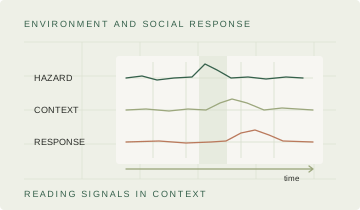
I help develop MLEED’s multilingual data and modeling pipeline. We bring environmental hazards together with displacement, community action, and policy responses, making their visibility in local news easier to examine.
- Translate and screen news, then classify hazards and societal responses.
- Aggregate by country and month with news-volume normalization.
- Public snapshot: 69 countries, 2012–2025, with validation and coverage documentation.